Reverse Tax Examples by Rate: How Much Tax Is Included in a Total of 100?
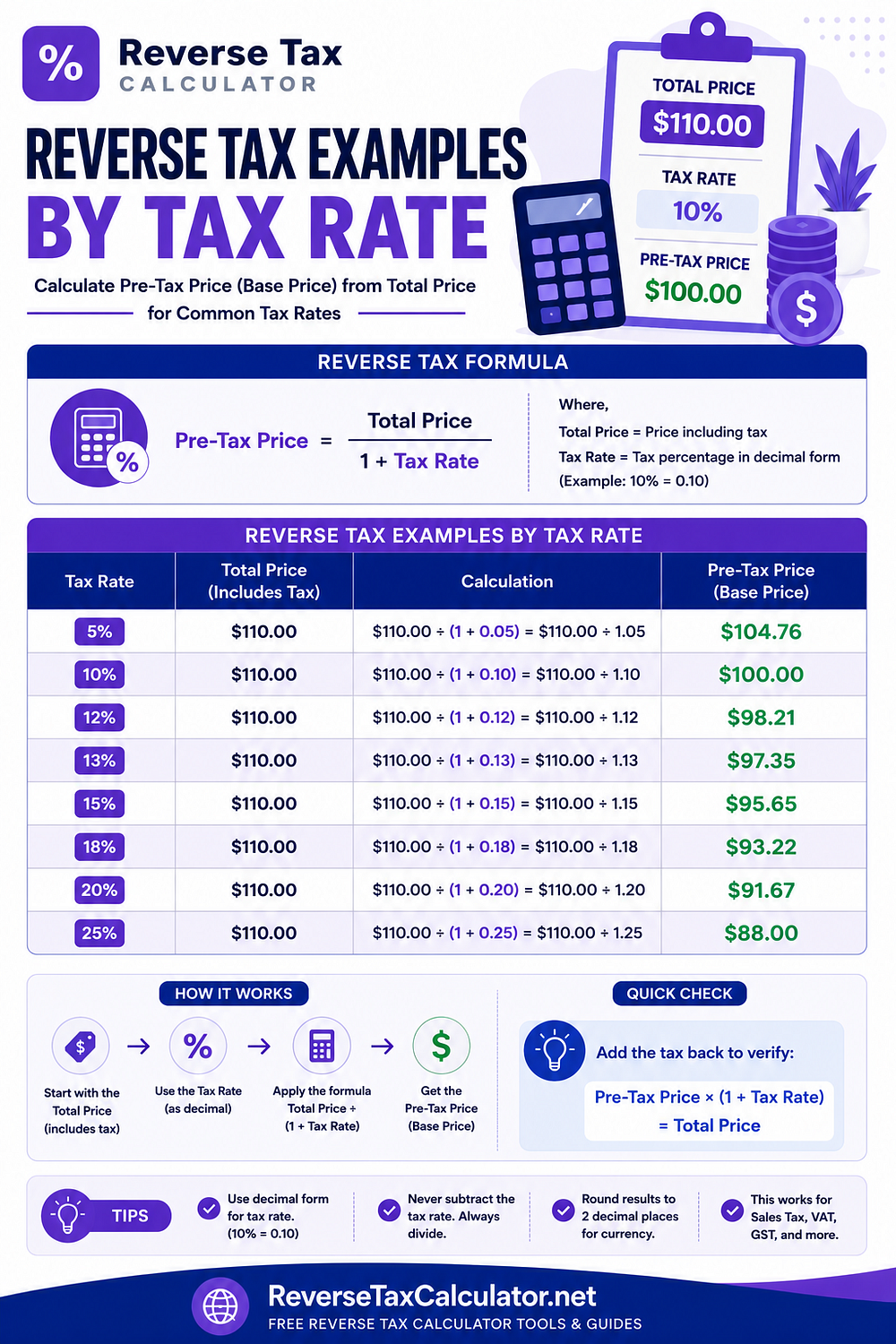
Reverse Tax Examples by Rate: How Much Tax Is Included in a Total of 100?
When a price already includes tax, the listed tax rate is not the percentage you should subtract from the final total.
For example, if a total of 100.00 includes 20% tax, the included tax is not 20.00. The correct tax amount is approximately 16.67, while the price before tax is approximately 83.33.
This happens because the 20% rate was applied to the original price before tax, not to the final tax-inclusive total.
In this guide, we will compare reverse-tax calculations at several common rates using the same final total of 100.00.
For a larger comparison with additional explanations, rounding notes, and rate-specific examples, read the complete reverse tax examples by tax rate guide.
The Reverse Tax Formula
To find the price before tax from a total that already includes tax, use:
Price before tax = Tax-inclusive total ÷ (1 + tax rate as a decimal)
You can then find the included tax with:
Included tax = Tax-inclusive total - Price before tax
For example, at a rate of 10%:
100 ÷ 1.10 = 90.91
The included tax is:
100 - 90.91 = 9.09
The 10% rate was applied to the 90.91 price before tax. It was not applied to the final 100.00 total.
Reverse Tax Comparison Table
The table below uses a tax-inclusive total of 100.00 for every example.
| Tax rate | Tax multiplier | Price before tax | Included tax |
|---|---|---|---|
| 0% | 1.00 | 100.00 | 0.00 |
| 5% | 1.05 | 95.24 | 4.76 |
| 7% | 1.07 | 93.46 | 6.54 |
| 8% | 1.08 | 92.59 | 7.41 |
| 10% | 1.10 | 90.91 | 9.09 |
| 13% | 1.13 | 88.50 | 11.50 |
| 20% | 1.20 | 83.33 | 16.67 |
As the tax rate increases, the price before tax becomes lower and the tax included in the same 100.00 total becomes higher.
However, the included tax is still smaller than the listed tax rate percentage of the final total.
Reverse Tax at 0%
At a 0% rate, there is no tax to remove.
Calculation:
100 ÷ 1.00 = 100.00
Included tax:
100 - 100 = 0.00
Result:
Price before tax: 100.00
Included tax: 0.00
Final total: 100.00
A 0% calculation may apply arithmetically to a zero-rated or non-taxed amount, but the actual classification of the transaction should still be verified.
Reverse Tax at 5%
At 5%, divide the tax-inclusive total by 1.05.
Calculation:
100 ÷ 1.05 = 95.238095...
Rounded price before tax:
95.24
Included tax:
100 - 95.24 = 4.76
Result:
Price before tax: 95.24
Included tax: 4.76
Final total: 100.00
Notice that the included tax is 4.76, not 5.00.
The 5% rate applies to 95.24:
95.24 × 5% ≈ 4.76
Reverse Tax at 7%
At 7%, use a multiplier of 1.07.
Calculation:
100 ÷ 1.07 = 93.457943...
Rounded price before tax:
93.46
Included tax:
100 - 93.46 = 6.54
Result:
Price before tax: 93.46
Included tax: 6.54
Final total: 100.00
Reverse Tax at 8%
At 8%, use a multiplier of 1.08.
Calculation:
100 ÷ 1.08 = 92.592592...
Rounded price before tax:
92.59
Included tax:
100 - 92.59 = 7.41
Result:
Price before tax: 92.59
Included tax: 7.41
Final total: 100.00
Multiplying 100 by 8% would give 8.00, but that would incorrectly calculate tax from the final total.
The original tax was calculated from the smaller price before tax.
Reverse Tax at 10%
At 10%, divide the tax-inclusive total by 1.10.
Calculation:
100 ÷ 1.10 = 90.909090...
Rounded price before tax:
90.91
Included tax:
100 - 90.91 = 9.09
Result:
Price before tax: 90.91
Included tax: 9.09
Final total: 100.00
A useful shortcut is that tax included at a 10% rate equals one eleventh of the tax-inclusive total:
100 ÷ 11 = 9.09
This shortcut applies only when the full total is taxable at one 10% rate.
Reverse Tax at 13%
At 13%, divide the final total by 1.13.
Calculation:
100 ÷ 1.13 = 88.495575...
Rounded price before tax:
88.50
Included tax:
100 - 88.50 = 11.50
Result:
Price before tax: 88.50
Included tax: 11.50
Final total: 100.00
The same formula can be used for VAT, GST, HST, or sales-tax calculations when the entire total is subject to one 13% rate.
The applicable tax rate and taxability must still be confirmed for the actual transaction.
Reverse Tax at 20%
At 20%, divide the total by 1.20.
Calculation:
100 ÷ 1.20 = 83.333333...
Rounded price before tax:
83.33
Included tax:
100 - 83.33 = 16.67
Result:
Price before tax: 83.33
Included tax: 16.67
Final total: 100.00
At a 20% tax rate, the included tax represents one sixth of the final tax-inclusive total:
20 ÷ 120 = 1 ÷ 6
Therefore:
100 ÷ 6 = 16.67
This is why a total of 100.00 including 20% tax contains 16.67 in tax rather than 20.00.
Tax Rate Versus Tax Share of the Final Total
The tax rate and the tax share of the final total are not the same percentage.
The tax rate is applied to the price before tax.
The tax share measures how much of the final tax-inclusive total consists of tax.
For a tax-inclusive total of 100.00:
| Tax rate | Included tax | Tax share of final total |
|---|---|---|
| 5% | 4.76 | 4.76% |
| 7% | 6.54 | 6.54% |
| 8% | 7.41 | 7.41% |
| 10% | 9.09 | 9.09% |
| 13% | 11.50 | 11.50% |
| 20% | 16.67 | 16.67% |
These figures match the included-tax amounts only because the example total is exactly 100.00.
For any other total, calculate the actual tax amount first and then divide it by the final total to determine its share.
Why You Should Not Multiply the Final Total by the Rate
A common mistake is calculating:
Included tax = Final total × Tax rate
For a total of 100.00 at 20%, that method gives:
100 × 20% = 20.00
This is incorrect because it treats 100.00 as the amount before tax.
The correct relationship is:
83.33 + 20% of 83.33 = 100.00
The tax is therefore approximately 16.67.
To reverse a tax-inclusive total, divide by the tax multiplier. Do not multiply the final total by the listed rate.
How Rounding Can Affect the Result
Reverse-tax calculations often produce several decimal places.
For example:
100 ÷ 1.08 = 92.592592...
When rounded to two decimal places, the price before tax becomes 92.59.
The included tax is then:
100.00 - 92.59 = 7.41
Depending on how a seller calculates and rounds each item, a receipt-level calculation may differ from an item-level calculation by one cent.
For reconciliation work, use the tax figures printed on the original receipt or invoice when they are available.
When These Examples Work
These rate examples are useful when:
The total already includes tax
One tax rate applies to the whole total
The correct rate is known
The amount does not mix taxable and exempt items
The total does not combine several differently taxed categories
The simple formula may not be enough when:
Several tax rates appear on one receipt
Part of the purchase is tax-exempt
Taxes are compounded
Discounts or fees receive different tax treatment
Shipping is taxed differently from the products
The applicable rate is unknown
In those cases, separate the transaction into rate groups before calculating.
Calculate Your Own Amount
The examples above all use a total of 100.00 to make comparison easier.
For your own receipt, invoice, or listed price, enter the actual tax-inclusive total and applicable rate into the free Reverse Tax Calculator.
The calculator can instantly show:
The price before tax
The included tax amount
The tax-inclusive total
The calculation used
Final Takeaway
The main rule is simple:
Do not subtract the tax rate directly from a tax-inclusive total.
Instead, divide the final total by one plus the tax rate as a decimal.
For a total of 100.00:
At 5%, the included tax is 4.76
At 10%, the included tax is 9.09
At 13%, the included tax is 11.50
At 20%, the included tax is 16.67
For more comparisons, explanations, and rate-specific calculations, visit the full Reverse Tax Examples by Tax Rate resource.
Comments
Post a Comment