How to Reverse Tax for Refunds and Returns
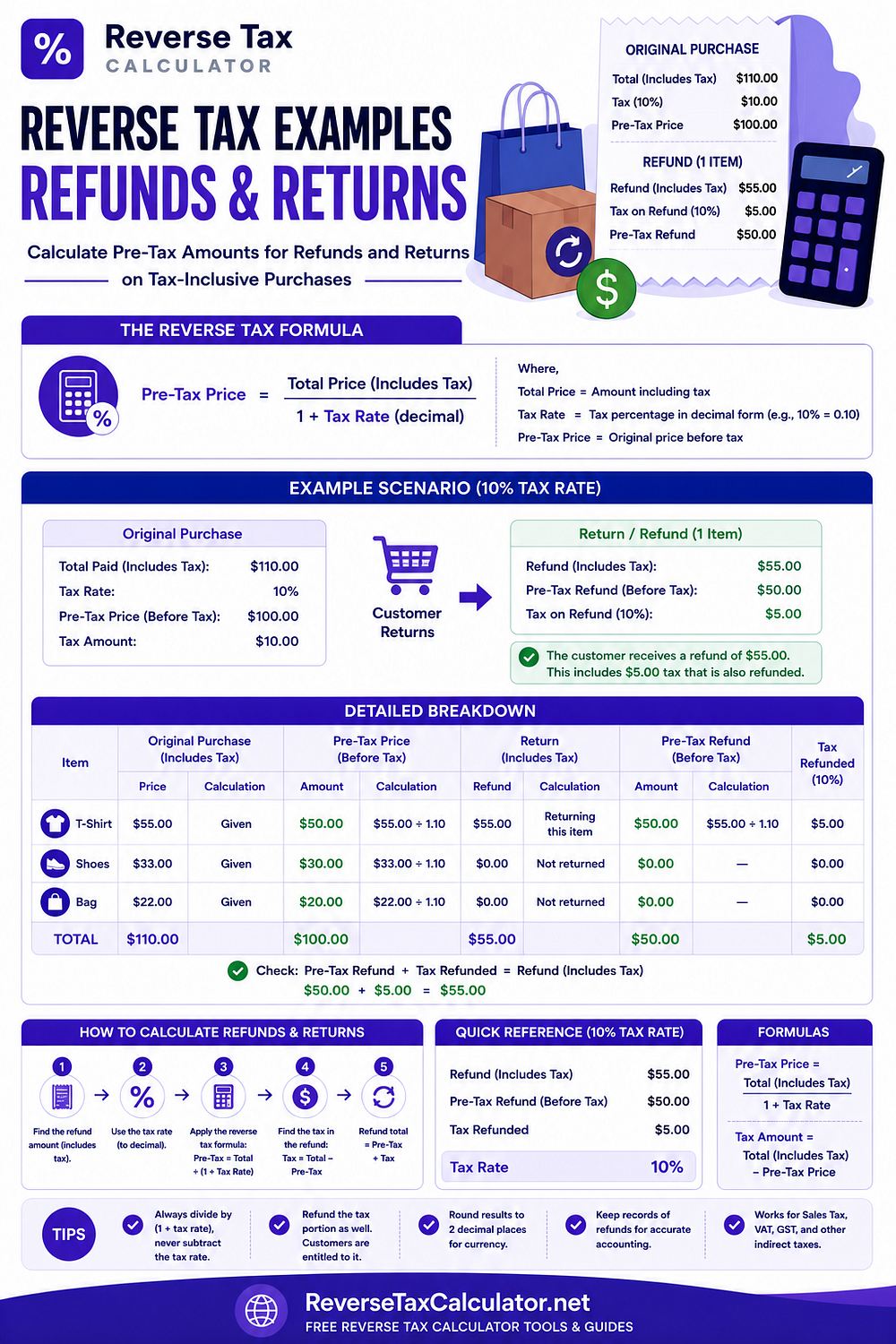
Refunds and product returns may appear to be ordinary reverse-tax calculations.
If a customer receives a tax-inclusive refund of $108.00 for an item originally taxed at 8%, the calculation is straightforward:
Pre-tax refund = $108.00 ÷ 1.08 = $100.00
Refunded tax = $108.00 - $100.00 = $8.00
The refund contains:
$100.00 returned item price
$8.00 returned tax
$108.00 total returned to the customer
However, not every refund is a clean reversal of an original sale.
A refund can also contain:
Partial item returns
Non-refundable shipping
Restocking fees
Store credit
Goodwill credits
Discounts and coupons
Marketplace adjustments
Exchange price differences
Gift-card value
Several tax rates
Exempt items
The most important rule is:
Match the refund to the original taxable transaction before calculating.
Do not automatically reverse tax from the amount of cash returned.
For additional refund examples, accounting controls, and decision tables, read How to Reverse Tax for Refunds and Returns.
What Does Reverse Tax on a Refund Mean?
Reverse tax on a refund means separating a tax-inclusive refund into:
The returned price before tax
The tax returned to the customer
The basic relationship is:
Tax-inclusive refund = Pre-tax refund + Refunded tax
This calculation may help a seller, accountant, or customer understand:
How much product value was returned
How much tax was returned
Whether the refund matches the original sale
Whether a partial return used the correct tax rate
How the refund should be reconciled with sales and settlement records
Reverse-tax arithmetic does not determine whether a customer is legally entitled to a refund or whether a tax return can be amended. Those decisions depend on transaction evidence and applicable rules.
Refund Reverse-Tax Formula
When a refund includes tax from a taxable sale, use:
Pre-tax refund = Tax-inclusive refund ÷ (1 + Original tax rate)
Then calculate:
Refunded tax = Tax-inclusive refund - Pre-tax refund
When the rate is written as a whole percentage:
Pre-tax refund = Refund total ÷ (1 + Rate ÷ 100)
For an 8% rate:
1 + 8 ÷ 100 = 1.08
For a 20% rate:
1 + 20 ÷ 100 = 1.20
Use the rate that applied to the original sale, not automatically the current rate.
Full Refund Example
Suppose the original sale was:
| Sale line | Amount |
|---|---|
| Item price before tax | $100.00 |
| Tax at 8% | $8.00 |
| Total paid | $108.00 |
The customer returns the item and receives a full refund of $108.00.
Reverse the refund:
$108.00 ÷ 1.08 = $100.00
Refunded tax:
$108.00 - $100.00 = $8.00
The refund reverses:
$100.00 of taxable sales
$8.00 of collected tax
$108.00 of customer payment
This is the cleanest refund case because the refund mirrors the original sale.
Why the Original Receipt Matters
The original receipt can confirm:
The item returned
Original item price
Original tax rate
Taxability of the item
Discounts applied
Shipping charged
Tax shown
Payment method
Original transaction date
Without the original sale record, it may be difficult to know whether the refund amount includes tax or which rate should be used.
For example, a refund of $108.00 might represent:
$100.00 plus 8% tax
$90.00 product value plus shipping and tax
A store credit unrelated to a taxable return
A partially refunded mixed-rate order
A refund reduced by a restocking fee
The amount alone does not explain the transaction.
Partial Refund Example
Suppose an original order contains two taxable items:
| Item | Pre-tax price | Tax at 8% | Total |
|---|---|---|---|
| Item A | $50.00 | $4.00 | $54.00 |
| Item B | $50.00 | $4.00 | $54.00 |
| Order total | $100.00 | $8.00 | $108.00 |
The customer returns only Item A and receives $54.00.
Reverse only the returned line:
$54.00 ÷ 1.08 = $50.00
Refunded tax:
$54.00 - $50.00 = $4.00
The remaining sale is:
Item B before tax: $50.00
Remaining tax: $4.00
Remaining tax-inclusive sale: $54.00
Do not reverse the full $108.00 order when only one item was returned.
Partial Quantity Return
Suppose a customer purchased four identical items:
Price per item before tax: $25.00
Quantity: 4
Pre-tax subtotal: $100.00
Tax at 8%: $8.00
Total: $108.00
The customer returns one item.
Tax-inclusive refund per item:
$108.00 ÷ 4 = $27.00
Reverse the returned amount:
$27.00 ÷ 1.08 = $25.00
Refunded tax:
$27.00 - $25.00 = $2.00
The return reverses one-fourth of the original sale and one-fourth of the original tax.
This method assumes the items had equal prices, tax treatment, and discount allocation.
What If the Refund Does Not Include Tax?
Not every customer credit includes tax.
Examples may include:
Goodwill credit
Customer service compensation
Late-delivery credit
Promotional credit
Shipping-only refund
Restocking adjustment
Price-match credit
Courtesy store balance
Suppose a seller issues a $10.00 goodwill credit because an order arrived late.
The customer keeps the products.
No tax is returned.
The $10.00 credit should not automatically be divided by the original tax multiplier.
The credit may reduce cash or create an expense without reversing the original taxable sale.
The refund record should indicate whether:
Product value was returned
Tax was returned
Shipping was returned
The credit was promotional
The original sale remained unchanged
Cash Returned Is Not Always the Refund Base
A customer may receive $98.00 after returning an item originally sold for $108.00.
It may seem reasonable to calculate:
$98.00 ÷ 1.08
However, suppose the transaction was:
Original item price: $100.00
Original tax: $ was8.00
Original total: $108.00
Restocking fee retained: $10.00
Cash returned: $98.00
The $98.00 cash refund does not reveal whether:
Tax was refunded on the full $100.00 item
Tax was refunded only on $90.00
The $10.00 fee was taxable
The fee was retained after a full tax reversal
The seller used another refund policy
The cash amount should be reconciled after the refund lines are identified.
Do not force the net cash refund into a reverse-tax formula without knowing what it contains.
Restocking Fee Example
Suppose:
Original item price: $200.00
Tax at 8%: $16.00
Original total: $216.00
Restocking fee: $20.00
Cash refund: $196.00
The refund receipt should separately show:
Returned item value
Refunded tax
Restocking fee
Net cash returned
Possible accounting presentation:
| Refund component | Amount |
|---|---|
| Item value reversed | $200.00 |
| Tax returned | $16.00 |
| Gross refund | $216.00 |
| Restocking fee retained | -$20.00 |
| Cash returned | $196.00 |
In this structure, the seller returned the full item value and tax, then retained a separate fee.
Another seller or jurisdiction may treat the transaction differently.
The net $196.00 cash alone is not enough evidence to determine the tax reversal.
Shipping Refund Example
Shipping requires separate analysis.
Ask:
Was shipping refunded?
Was shipping taxable in the original sale?
Did shipping use the same rate as the item?
Was only part of the shipping refunded?
Was the shipping charge retained?
Shipping not refunded
Original order:
| Line | Amount |
|---|---|
| Item before tax | $100.00 |
| Tax at 8% | $8.00 |
| Non-refundable shipping | $10.00 |
| Total | $118.00 |
The customer returns the product, but shipping is not refunded.
Refund:
$108.00
Reverse the product refund:
$108.00 ÷ 1.08 = $100.00
Refunded tax:
$8.00
The $10.00 shipping remains outside the refund calculation.
Non-taxable shipping refunded
Suppose the customer receives:
Product refund including tax: $108.00
Non-taxable shipping refund: $10.00
Total refund: $118.00
Do not reverse the full $118.00 at 8%.
Separate:
Taxable refund group: $108.00
Non-taxable shipping refund: $10.00
Reverse only $108.00.
Taxable shipping refunded
Suppose:
Product before tax: $100.00
Taxable shipping: $10.00
Taxable base: $110.00
Tax at 8%: $8.80
Original total: $118.80
If the complete sale is refunded:
$118.80 ÷ 1.08 = $110.00
Refunded tax:
$118.80 - $110.00 = $8.80
The pre-tax refund contains both product value and taxable shipping.
Refund of an Exempt Item
Suppose an exempt item cost $50.00.
No tax was charged.
When the customer returns it:
Item refund: $50.00
Refunded tax: $0.00
Total refund: $50.00
Do not apply a positive tax rate to the refund.
An exempt item contains no tax to reverse.
Refund From a Mixed Taxable and Exempt Order
Suppose the original order contains:
Taxable item: $100.00
Tax at 8%: $8.00
Exempt item: $50.00
Total: $158.00
Customer returns only the taxable item
Refund:
$108.00
Reverse:
$108.00 ÷ 1.08 = $100.00
Refunded tax:
$8.00
Customer returns only the exempt item
Refund:
$50.00
Refunded tax:
$0.00
Customer returns both items
Total refund:
$158.00
Do not divide the complete $158.00 by 1.08.
Separate:
Taxable refund: $108.00
Exempt refund: $50.00
The before-tax returned value is:
$100.00 + $50.00 = $150.00
Refunded tax is:
$8.00
Refund From a Mixed-Rate Order
Suppose an order contains:
Item A: $105.00 including 5% tax
Item B: $120.00 including 20% tax
Order total: $225.00
The customer returns both items.
Reverse each tax group separately.
Item A
$105.00 ÷ 1.05 = $100.00
Refunded tax:
$5.00
Item B
$120.00 ÷ 1.20 = $100.00
Refunded tax:
$20.00
Combined refund:
Returned value before tax: $200.00
Refunded tax: $25.00
Total refund: $225.00
Do not use one average rate for the complete return.
Discounts and Refunds
A return should normally trace back to the taxable price used in the original sale.
Suppose:
Original list price: $100.00
Store discount: $20.00
Taxable selling price: $80.00
Tax at 8%: $6.40
Total paid: $86.40
If the item is fully returned:
$86.40 ÷ 1.08 = $80.00
Refunded tax:
$6.40
The return reverses the discounted taxable price of $80.00.
It does not automatically refund the original $100.00 list price.
Coupon Allocation on Partial Returns
Suppose a customer buys two items:
Item A list price: $50.00
Item B list price: $50.00
Order-level store coupon: $20.00
Discounted subtotal: $80.00
Tax at 8%: $6.40
Total: $86.40
If the discount is allocated evenly:
Item A discounted price: $40.00
Item B discounted price: $40.00
Tax per item: $3.20
Tax-inclusive item value: $43.20
If Item A is returned, its refund may be:
$43.20
Reverse:
$43.20 ÷ 1.08 = $40.00
Refunded tax:
$3.20
The original discount allocation should be preserved.
Do not refund the undiscounted $50.00 item value unless the return policy and records support that amount.
Manufacturer Coupons and Returns
Manufacturer-funded coupons can complicate returns because:
The customer paid less
The seller may have received reimbursement
Tax may have been calculated on a different base
Coupon value may not be returned as cash
Refund policy may exclude the coupon value
For example:
Shelf price: $100.00
Manufacturer coupon: $20.00
Customer item payment: $80.00
Tax charged on $100.00 at 8%: $8.00
Customer payment: $88.00
A return may involve:
$80.00 returned to the customer
$8.00 tax returned
Coupon value handled separately
Manufacturer reimbursement reversal
The $88.00 refund does not behave like an ordinary $88.00 tax-inclusive price because tax was calculated on $100.00.
Use the original receipt and coupon treatment rather than relying on one simple reverse-tax formula.
How Exchanges Affect Reverse Tax
An exchange is often best understood as two separate events:
Return of the original item
New sale of the replacement item
Keeping the events separate helps preserve:
Returned item value
Refunded tax
Replacement item value
New tax charged
Cash difference
Store credit
Inventory movement
Equal Exchange
Suppose a customer exchanges:
Original item before tax: $100.00
Replacement item before tax: $100.00
Rate: 8%
Original return:
Revenue reversal: $100.00
Tax reversal: $8.00
Replacement sale:
New revenue: $100.00
New tax: $8.00
Net customer payment:
$0.00
Net tax effect may also be zero.
However, the records should still show the return and replacement sale separately.
Higher-Value Exchange
Suppose:
Returned item before tax: $100.00
Replacement item before tax: $150.00
Rate: 8%
Price difference:
$150.00 - $100.00 = $50.00
Tax on difference:
$50.00 × 8% = $4.00
Additional customer payment:
$50.00 + $4.00 = $54.00
The exchange may be recorded as:
Return: $100.00 plus $8.00 tax
New sale: $150.00 plus $12.00 tax
Net difference: $50.00 plus $4.00 tax
Do not treat the $54.00 payment difference as though it were the full replacement sale.
Lower-Value Exchange
Suppose:
Returned item before tax: $150.00
Replacement item before tax: $100.00
Rate: 8%
Price difference returned:
$150.00 - $100.00 = $50.00
Tax difference:
$50.00 × 8% = $4.00
Customer refund:
$54.00
Reverse the $54.00 difference:
$54.00 ÷ 1.08 = $50.00
Refunded tax:
$4.00
The return and replacement should still be preserved as separate lines.
Store Credit Instead of Cash Refund
A store credit can replace a cash refund without necessarily changing the tax logic.
Suppose a customer returns a taxable item:
Item value before tax: $100.00
Tax: $8.00
Tax-inclusive return value: $108.00
The customer receives a store credit of $108.00.
The form of payment changed from cash to credit, but the original taxable sale may still have been reversed.
The refund record should show:
Returned product value: $100.00
Returned tax: $8.00
Store credit issued: $108.00
However, a $10.00 promotional store credit issued as goodwill is different.
It may not represent the return of a taxable item and may not include refundable tax.
Marketplace Refunds
Marketplace refunds should be analyzed using order-level refund details.
A marketplace report may contain:
Item refund
Tax refund
Shipping refund
Seller fee refund
Processing-fee adjustment
Reserve adjustment
Payout reduction
The net payout reduction is not automatically the tax-inclusive refund base.
Suppose:
Item refund: $100.00
Tax refund: $8.00
Shipping retained: $10.00
Platform fee adjustment: $5.00
Future payout reduced by $103.00
The $103.00 settlement effect should not be divided by 1.08.
The tax calculation belongs to:
Item refund: $100.00
Refunded tax: $8.00
The fee and payout adjustments belong to marketplace reconciliation.
Who Originally Collected the Tax?
When a marketplace is involved, determine whether:
The seller collected and remitted tax
The marketplace collected and remitted tax
The marketplace refunded the tax
The seller refunded the tax
The platform adjusted a clearing account
The tax change appears in a later report
If the marketplace originally handled the tax, the seller should avoid recording a duplicate tax-payable adjustment.
Use the platform’s order-level tax and refund reports.
Refund Timing and Marketplace Payouts
A sale and refund may appear in different accounting periods.
Example:
Sale completed in June
Refund issued in July
Marketplace reduces a July payout
The lower July bank deposit does not mean the entire difference is a July tax-inclusive sale adjustment.
The refund should be matched back to:
Original June order
Returned item
Original tax rate
Refunded tax
July settlement adjustment
This preserves the connection between transaction activity and cash timing.
What If the Tax Rate Changed?
Use the original sale rate when reversing the original transaction.
Suppose:
Original sale occurred at 8%
Current rate is 9%
Customer returns the item after the rate change
If the original tax-inclusive sale was $108.00:
$108.00 ÷ 1.08 = $100.00
Using the current 9% rate would give:
$108.00 ÷ 1.09 = $99.08
That would not match the original sale.
A refund issued in a later year should generally trace back to the original transaction facts.
If the original rate cannot be found, clearly label the result as an estimate.
Refund Reporting
For clean reporting, separate:
| Report line | Example |
|---|---|
| Revenue reversed | $100.00 |
| Tax reversed | $8.00 |
| Gross refund | $108.00 |
| Restocking fee retained | Separate line |
| Shipping refunded | Separate line |
| Marketplace fee adjustment | Separate line |
| Net cash impact | Settlement line |
Do not record the entire refund as one miscellaneous expense if it represents a returned sale.
Separating revenue, tax, fees, and cash helps preserve:
Gross sales
Returns
Net sales
Tax collected
Tax refunded
Settlement reconciliation
Sales Tax Payable and Refunds
When tax was collected and later returned to the customer, the related tax liability or tax-clearing balance may need to be adjusted.
However, tax should not be reduced automatically merely because cash was returned.
Examples that may not include tax reversal include:
Goodwill payment
Non-taxable shipping refund
Promotional credit
Restocking adjustment
Seller-funded compensation unrelated to a returned taxable item
The refund record should clearly identify the tax returned.
Applicable reporting rules should be verified before changing filed or payable amounts.
Refund Spreadsheet Formulas
Suppose:
A2 contains the tax-inclusive refund
B2 contains the original tax rate as a percentage
Pre-tax refund
=A2/(1+B2)
Refunded tax
=A2-(A2/(1+B2))
Rebuilt refund
If C2 contains the pre-tax refund and D2 contains refunded tax:
=C2+D2
Variance
=A2-(C2+D2)
If B2 contains the whole number 8 instead of 8%, use:
=A2/(1+B2/100)
Suggested Refund Worksheet
| Column | Heading |
|---|---|
| A | Original order ID |
| B | Original sale date |
| C | Refund date |
| D | Returned item |
| E | Original tax status |
| F | Original rate |
| G | Tax-inclusive returned amount |
| H | Pre-tax refund |
| I | Refunded tax |
| J | Shipping refunded |
| K | Restocking fee |
| L | Store credit |
| M | Cash returned |
| N | Marketplace adjustment |
| O | Notes |
This format helps prevent the net cash amount from replacing the actual refund details.
Refund Decision Table
| Refund type | Reverse tax? | Recommended action |
|---|---|---|
| Full taxable refund including tax | Yes | Reverse full returned taxable line |
| Partial taxable refund including tax | Yes | Match returned item |
| Exempt item refund | No positive tax | Preserve exempt refund |
| Goodwill credit | Usually separate | Confirm whether tax changed |
| Store credit for taxable return | Possibly yes | Track tax and credit separately |
| Promotional store credit | Usually separate | Do not assume tax reversal |
| Shipping-only refund | Depends | Check shipping taxability |
| Restocking fee | Separate | Do not infer tax from net cash |
| Equal exchange | Return plus new sale | Preserve both events |
| Higher-value exchange | Tax may apply to difference | Record new sale detail |
| Lower-value exchange | Partial refund may include tax | Match difference and rate |
| Marketplace refund | Use platform detail | Avoid reversing payout reduction |
| Old sale after rate change | Use original rate | Match original receipt |
Operational Refund Workflow
Step 1: Find the original sale
Confirm the item, price, rate, taxability, and tax charged.
Step 2: Identify what was returned
Do not reverse unreturned products.
Step 3: Confirm whether tax was refunded
Use the refund receipt or platform report.
Step 4: Separate refund components
Identify:
Item value
Tax
Shipping
Restocking fee
Credit
Marketplace fee
Cash returned
Step 5: Reverse the tax-inclusive returned line
Use the original rate.
Step 6: Record the refund method
Cash, card reversal, gift card, and store credit should be tracked separately.
Step 7: Reconcile the settlement
Match the refund with processor or marketplace reports.
Step 8: Save supporting records
Preserve the original receipt, refund receipt, return reason, and platform report.
Common Refund Tax Mistakes
Reversing only the cash returned
Restocking fees or payment adjustments may have changed the cash amount.
Using the current tax rate
The refund should normally match the original transaction rate.
Reversing the entire order for a partial return
Only the returned taxable line should be reversed.
Reducing tax when none was refunded
A goodwill or non-taxable credit may not change the tax liability.
Treating an exchange as one refund
An exchange may contain both a return and a new sale.
Ignoring shipping treatment
Shipping may be taxable, non-taxable, refunded, or retained.
Reversing a marketplace payout reduction
Settlement changes can include fees and timing differences.
Double-adjusting marketplace tax
Determine who originally collected and remitted the tax.
Refund Audit Checklist
Before accepting the calculation, confirm:
The original sale was found.
The returned item was identified.
The original tax rate was used.
Original taxability was confirmed.
Tax was actually refunded.
Partial returns were calculated by line.
Discounts were allocated correctly.
Shipping was separated.
Restocking fees were recorded separately.
Store credit was classified correctly.
Marketplace remittance responsibility was identified.
The refund reconciles with the cash or payout record.
The original and refund receipts were saved.
Any estimate is clearly labeled.
Use the Calculator for a Clean Tax-Inclusive Refund
After identifying the returned taxable line and original rate, use the free Reverse Tax Calculator.
Enter:
The tax-inclusive refund amount
The original tax rate
The calculator can show:
Pre-tax refund
Refunded tax
Tax multiplier
Calculation breakdown
Do not enter only the net cash refund when it has been reduced by restocking fees, shipping adjustments, credits, or marketplace offsets.
Final Takeaway
A refund should reverse the tax calculation connected to the original returned item.
For a clean tax-inclusive refund:
Pre-tax refund = Refund total ÷ (1 + Original rate)
Then:
Refunded tax = Refund total - Pre-tax refund
The calculation becomes more complicated when the refund includes:
Partial returns
Exempt items
Multiple rates
Discounts
Manufacturer coupons
Restocking fees
Shipping
Store credit
Exchanges
Marketplace adjustments
The best workflow starts with the original taxable line, not the final cash that moved.
For more examples and refund-specific decision guidance, read How to Reverse Tax for Refunds and Returns.
This article was originally published on Reverse Tax Calculator.
Comments
Post a Comment