How Discounts and Coupons Affect Reverse Tax
How
How Discounts and Coupons Affect Reverse Tax
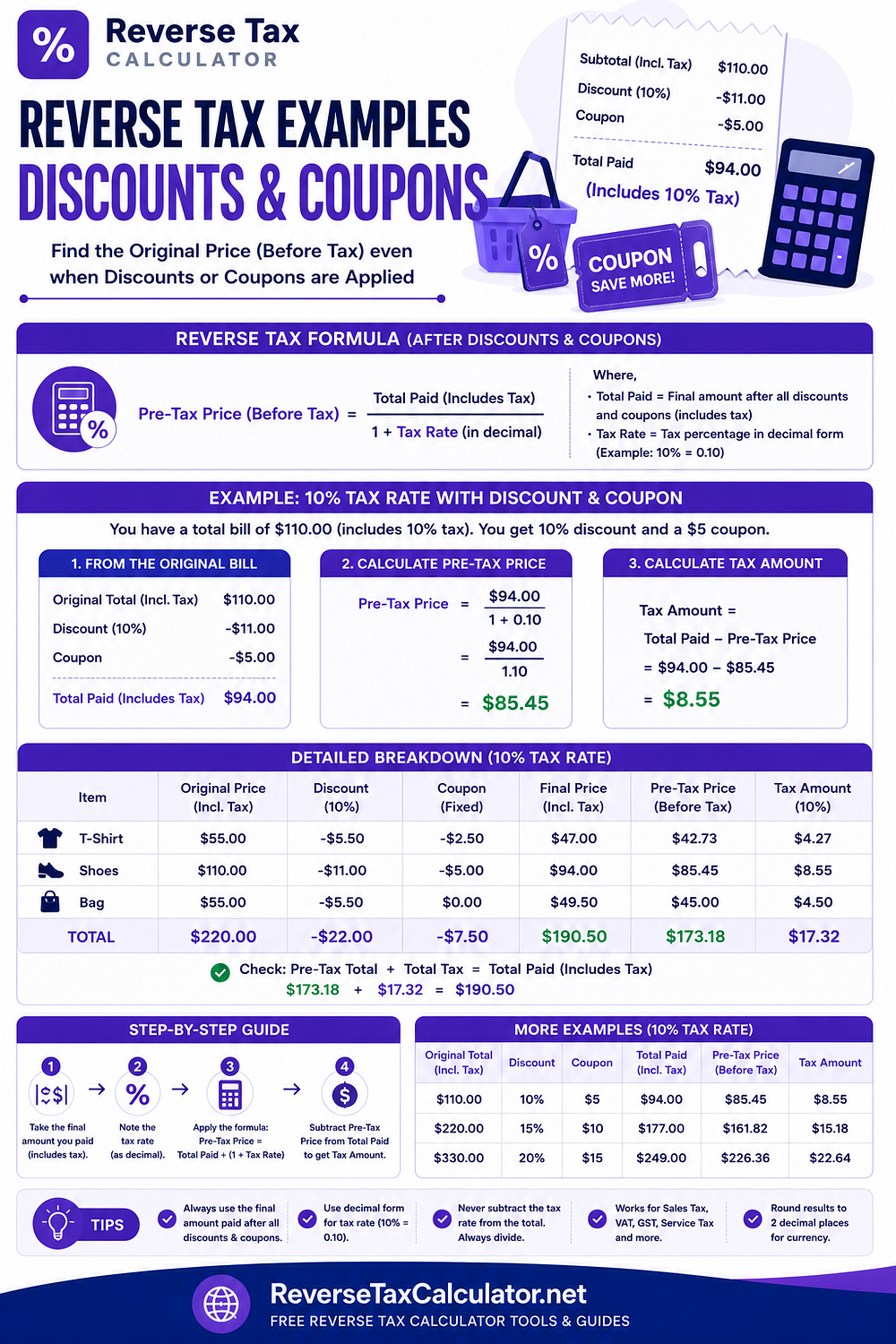
Discounts and coupons can change more than the amount a customer pays. They can also change the taxable price used to calculate sales tax, VAT, GST, or another transaction tax.
However, not every promotion affects tax in the same way.
A retailer discount may reduce the taxable selling price before tax is calculated. A manufacturer coupon may be reimbursed by a third party, which can leave the taxable base higher than the customer’s cash payment. Gift cards and store credits may function as payment methods rather than discounts.
This creates an important reverse-tax question:
Did the promotion reduce the taxable selling price, or did it only reduce the amount the customer paid directly?
The answer determines which amount should be entered into a reverse-tax calculation.
For a complete explanation of coupon types, taxable-base decisions, and additional receipt examples, read How Discounts and Coupons Affect Reverse Tax.
The Basic Reverse-Tax Formula
When a discounted total includes tax at one known rate, use:
Price before tax = Tax-inclusive total ÷ (1 + Tax rate)
Then calculate the included tax:
Included tax = Tax-inclusive total - Price before tax
For example, suppose:
Discounted price before tax: $80.00
Tax rate: 8%
Tax: $6.40
Final total: $86.40
Reverse the total:
$86.40 ÷ 1.08 = $80.00
Included tax:
$86.40 - $80.00 = $6.40
This calculation works because the discount reduced the taxable price to $80.00 before tax was added.
Why Discounts Change Reverse Tax
Reverse tax depends on two connected values:
A tax-inclusive amount
The rate applied to the taxable base inside that amount
A discount can change the taxable base. When that happens, the reverse calculation should normally recover the discounted taxable price rather than the original shelf price.
Suppose:
Original price: $100.00
Store discount: $20.00
Discounted taxable price: $80.00
Rate: 8%
The tax is:
$80.00 × 8% = $6.40
The final total is:
$80.00 + $6.40 = $86.40
Reverse tax returns:
$86.40 ÷ 1.08 = $80.00
It does not return the original $100.00 shelf price because tax was calculated after the discount.
The Four Main Promotion Types
Discounted receipts become easier to understand when promotions are classified by what they actually do.
1. Retailer discount
A retailer discount is funded by the seller.
Examples include:
Store coupon
Promotional price reduction
Clearance discount
Loyalty discount funded by the store
Percentage-off sale
Member price with no third-party reimbursement
When the retailer permanently reduces the selling price before tax, the reduced amount is commonly the taxable base.
2. Manufacturer coupon
A manufacturer coupon is funded or reimbursed by the product manufacturer or another third party.
The customer may pay less, but the seller can receive value from both:
The customer
The manufacturer
Depending on the applicable jurisdiction, the reimbursed coupon value may remain part of taxable sales.
That means the customer’s cash payment before tax may be lower than the taxable base.
3. Rebate
A rebate may occur:
At the point of sale
After the purchase
Through the manufacturer
Through a mail-in claim
Through an account credit
A post-sale rebate often does not change the original taxable sale because tax was calculated before the customer received the later payment.
4. Payment credit
Gift cards, prepaid balances, and some store credits are payment methods rather than price reductions.
They may reduce the amount paid in cash or by card without reducing:
Selling price
Taxable base
Tax charged
Transaction total
Do not automatically treat every credit as a discount.
Retailer Coupon Example
Suppose a store offers its own $20 coupon on a $100 taxable item.
Receipt:
| Receipt line | Amount |
|---|---|
| Original item price | $100.00 |
| Store coupon | -$20.00 |
| Taxable subtotal | $80.00 |
| Tax at 8% | $6.40 |
| Final total | $86.40 |
The discount reduced the selling price before tax.
Reverse the final total:
$86.40 ÷ 1.08 = $80.00
Included tax:
$86.40 - $80.00 = $6.40
The reverse-tax result matches the discounted taxable subtotal.
Manufacturer Coupon Example
Now suppose the same $20 coupon is funded by the manufacturer.
Receipt structure:
| Receipt line | Amount |
|---|---|
| Shelf price | $100.00 |
| Manufacturer coupon | -$20.00 |
| Customer payment before tax | $80.00 |
| Tax calculated on $100.00 at 8% | $8.00 |
| Customer total | $88.00 |
A basic reverse calculation gives:
$88.00 ÷ 1.08 = $81.48
That result is neither:
The original shelf price of $100.00
The customer’s discounted pre-tax payment of $80.00
The formula appears to fail because $88.00 is not a clean total consisting of one taxable base plus tax.
The receipt contains:
$80.00 paid by the customer toward the selling price
$20.00 of manufacturer-funded value
$8.00 tax calculated from the $100.00 taxable base
The seller’s taxable value may therefore be larger than the customer’s direct payment.
For example, California’s tax authority explains that qualifying manufacturer-coupon reimbursements are included in taxable sales when the underlying sale is taxable. Rules vary, so the treatment must be verified for the applicable jurisdiction.
Why Customer Payment May Not Equal the Taxable Base
Many reverse-tax examples assume:
Customer payment before tax = Taxable base
Coupons can break that assumption.
A seller may receive value from:
Customer cash
Credit-card payment
Manufacturer reimbursement
Loyalty-program reimbursement
Promotional partner
Marketplace subsidy
The taxable base may reflect more than the amount the customer paid directly.
This is why a discounted receipt should be reconstructed by funding source rather than analyzed only from the bottom payment figure.
Use the Tax Line to Test the Coupon
When a receipt shows the tax amount, use it to test which taxable base was used.
Suppose:
Original price: $100.00
Coupon: $20.00
Rate: 8%
Final customer payment: $88.00
Test the discounted base:
$80.00 × 8% = $6.40
Test the original price:
$100.00 × 8% = $8.00
The customer paid $80.00 for the item plus $8.00 tax:
$80.00 + $8.00 = $88.00
The receipt’s tax amount matches tax on $100.00, not tax on $80.00.
This suggests that the coupon did not reduce the full taxable base.
Formula When the Tax Amount Is Shown
When both the tax amount and rate are known, calculate the implied taxable base with:
Taxable base = Tax amount ÷ Tax rate
Using the previous example:
$8.00 ÷ 0.08 = $100.00
This calculation reveals the taxable base directly.
It may be more informative than dividing the customer’s final payment by 1.08.
How Gift Cards Affect Reverse Tax
A gift card normally changes the payment method, not the selling price.
Suppose:
Price before tax: $100.00
Tax at 8%: $8.00
Transaction total: $108.00
Gift card used: $20.00
Card payment: $88.00
Do not reverse the $88.00 card payment.
The clean tax-inclusive transaction amount is $108.00:
$108.00 ÷ 1.08 = $100.00
The gift card explains how part of the $108.00 was paid.
It does not automatically reduce the taxable selling price to $80.00.
Store Credit May Require Classification
A store credit can represent different things.
It may be:
A refund from a previous transaction
A goodwill credit
A promotional discount
A prepaid balance
A payment instrument
A seller-funded price reduction
The label “store credit” is not enough to determine its tax effect.
Review:
Why the credit was issued
Whether it reduced the item price
Whether it appeared before or after the tax line
Whether the seller received reimbursement
How the receipt calculated tax
Loyalty Points Can Behave Differently
Loyalty points may function as:
A store-funded discount
A payment method
A manufacturer-funded reward
A third-party promotional credit
A reimbursement program
Suppose $10 in loyalty points is used on a $100 item.
Possible structures include:
Store-funded price reduction
Taxable price: $90.00
Tax at 8%: $7.20
Final total: $97.20
Reverse tax:
$97.20 ÷ 1.08 = $90.00
Payment credit
Taxable price: $100.00
Tax: $8.00
Transaction total: $108.00
Loyalty credit: $10.00
Remaining payment: $98.00
Reverse tax should begin with $108.00, not $98.00.
The receipt structure and program terms determine which interpretation applies.
Rebates Before and After Purchase
Rebates are not automatically the same as checkout discounts.
Point-of-sale rebate
A point-of-sale rebate may reduce the price before tax when it is treated as a selling-price reduction.
Example:
Original price: $100.00
Immediate rebate: $20.00
Taxable base: $80.00
Tax at 8%: $6.40
Final total: $86.40
Post-sale rebate
Suppose the customer pays:
Price before tax: $100.00
Tax: $8.00
Total at checkout: $108.00
The customer later receives a $20.00 rebate.
The original sale was still based on $100.00 before tax.
The later rebate should not automatically be subtracted from the original taxable total before reverse tax.
Prompt-Payment Discounts
A prompt-payment discount rewards a customer for paying within a specified period.
Example:
Invoice amount before discount: $100.00
Prompt-payment discount: 2%
Discounted amount: $98.00
Tax calculated on discounted amount where permitted
At an 8% rate:
$98.00 × 8% = $7.84
Tax-inclusive discounted amount:
$98.00 + $7.84 = $105.84
Reverse check:
$105.84 ÷ 1.08 = $98.00
However, treatment depends on the applicable rules and whether the discount was actually earned.
Discount Before Tax vs Discount After Tax
The sequence determines which amount should be reversed.
Discount before tax
Receipt order:
Original price
Discount
Reduced taxable subtotal
Tax
Total
The discount probably affected the taxable base.
Discount after tax
Receipt order:
Original taxable subtotal
Tax
Tax-inclusive total
Credit or reduction
Amount paid
The adjustment may have changed the payment without changing the taxable base.
Receipt order is useful evidence, but it is not always conclusive legal proof.
Worked Example: Discount Before Tax
Suppose:
Item price: $50.00
Store coupon: $10.00
Taxable subtotal: $40.00
Rate: 7.5%
Tax: $3.00
Total: $43.00
Reverse the total:
$43.00 ÷ 1.075 = $40.00
Included tax:
$43.00 - $40.00 = $3.00
The reverse-tax formula works normally because the coupon reduced the taxable base before tax.
Worked Example: Coupon Does Not Reduce the Full Base
Suppose:
Item price: $50.00
Manufacturer coupon: $10.00
Customer pays before tax: $40.00
Tax at 7.5% on $50.00: $3.75
Final customer payment: $43.75
A basic reverse calculation gives:
$43.75 ÷ 1.075 = $40.70
This result does not match:
Original price: $50.00
Discounted customer payment: $40.00
The customer total contains tax calculated from value outside the customer’s direct pre-tax payment.
Use the tax line:
$3.75 ÷ 0.075 = $50.00
The implied taxable base is $50.00.
Stacked Promotion Example
Suppose a receipt contains:
Original price: $120.00
Store discount: $20.00
Manufacturer coupon: $10.00
Gift card: $15.00
Rate: 8%
Do not combine the three promotions into a single $45 discount.
Classify them separately.
Store discount
This may reduce the selling price from $120.00 to $100.00.
Manufacturer coupon
This may reduce the customer’s payment by $10.00 without reducing the taxable base below $100.00.
Gift card
This may pay $15.00 of the remaining amount without changing the taxable base.
Possible receipt structure:
Taxable base: $100.00
Tax: $8.00
Transaction total: $108.00
Manufacturer coupon: $10.00
Gift card: $15.00
Remaining payment: $83.00
Reverse tax should follow the $108.00 transaction total, not the $83.00 remaining payment.
Decision Table
| Receipt clue | Likely role | Amount to examine first |
|---|---|---|
| Store coupon above tax line | Price reduction | Discounted taxable subtotal |
| Manufacturer coupon | Third-party funded value | Original taxable selling price |
| Gift card | Payment method | Total before gift-card redemption |
| Rebate after purchase | Post-sale payment | Original transaction total |
| Discount after tax line | Credit or payment adjustment | Total before the adjustment |
| Prompt-payment discount | Possible base reduction | Amount after earned discount |
| Loyalty points | Program-dependent | Receipt-defined taxable subtotal |
| Tax looks high after coupon | Base may not have fallen fully | Use tax line to infer base |
Practical Workflow
Step 1: Record the original price
Identify the price before all promotions.
Step 2: Classify each promotion
Determine whether it is:
Retailer-funded
Manufacturer-funded
Third-party-funded
A payment method
A later rebate
Step 3: Check the timing
Did the promotion appear before or after tax was calculated?
Step 4: Find the taxable subtotal
Use the receipt’s taxable subtotal when shown.
Step 5: Test the tax line
Calculate tax on both the original and discounted prices when treatment is uncertain.
Step 6: Reverse only a clean total
Use the basic reverse-tax formula only when the selected total contains one taxable base plus tax.
Step 7: Document the assumption
Record why the selected amount was treated as taxable.
Step 8: Verify jurisdiction-specific rules
Coupon and rebate treatment can differ by jurisdiction, program design, product category, and transaction date.
Common Errors
Treating every coupon as a retailer discount
This can understate the taxable base when the seller receives third-party reimbursement.
Treating a gift card as a discount
This can incorrectly reduce both the selling price and calculated tax.
Reversing only the final card payment
The card amount may already reflect gift cards, credits, or other payment instruments.
Ignoring the tax line
The actual tax amount may reveal which taxable base was used.
Combining stacked promotions
Different promotions may affect price, tax, reimbursement, or payment separately.
Applying one rule everywhere
Coupon treatment varies. One state, province, or country’s rule should not be presented as universal.
Spreadsheet Formulas
Suppose:
A2 contains a clean tax-inclusive discounted total
B2 contains the rate as a percentage
Price before tax:
=A2/(1+B2)
Included tax:
=A2-(A2/(1+B2))
When the tax amount is known in C2, calculate the implied taxable base with:
=C2/B2
If B2 contains the whole number 8 rather than 8%, use:
=C2/(B2/100)
Suggested worksheet columns:
| Column | Heading |
|---|---|
| A | Original price |
| B | Promotion type |
| C | Discount amount |
| D | Third-party reimbursement |
| E | Taxable base |
| F | Tax rate |
| G | Tax |
| H | Transaction total |
| I | Payment credit |
| J | Customer payment |
| K | Notes |
This structure prevents discounts, reimbursements, and payment methods from being combined into one misleading figure.
When to Use the Reverse Tax Calculator
Use a reverse-tax calculator when:
The discounted amount includes tax
The discount reduced the taxable selling price
One rate applies
The total does not include unrelated payment credits
The taxable group has been isolated
You can use the free Reverse Tax Calculator to calculate:
Discounted price before tax
Included tax
Tax multiplier
Calculation breakdown
When a manufacturer coupon, gift card, rebate, or stacked promotion is involved, reconstruct the receipt structure before entering a total.
Final Takeaway
Discounts and coupons affect reverse tax according to their source, timing, and effect on the taxable base.
A retailer-funded discount commonly reduces the selling price before tax.
A manufacturer-funded coupon may reduce customer payment while leaving some or all of the reimbursed value in the taxable base.
A gift card normally changes payment rather than selling price.
A post-sale rebate may occur after the original tax calculation is complete.
The safest approach is:
Identify the original price.
Classify the promotion.
Check whether the seller receives reimbursement.
Find the taxable subtotal.
Use the receipt’s tax line.
Reverse only a clean tax-inclusive amount.
Verify the applicable jurisdiction’s rules.
For more examples and a detailed coupon-treatment matrix, read How Discounts and Coupons Affect Reverse Tax.
This article was originally published on Reverse Tax Calculator.
Comments
Post a Comment